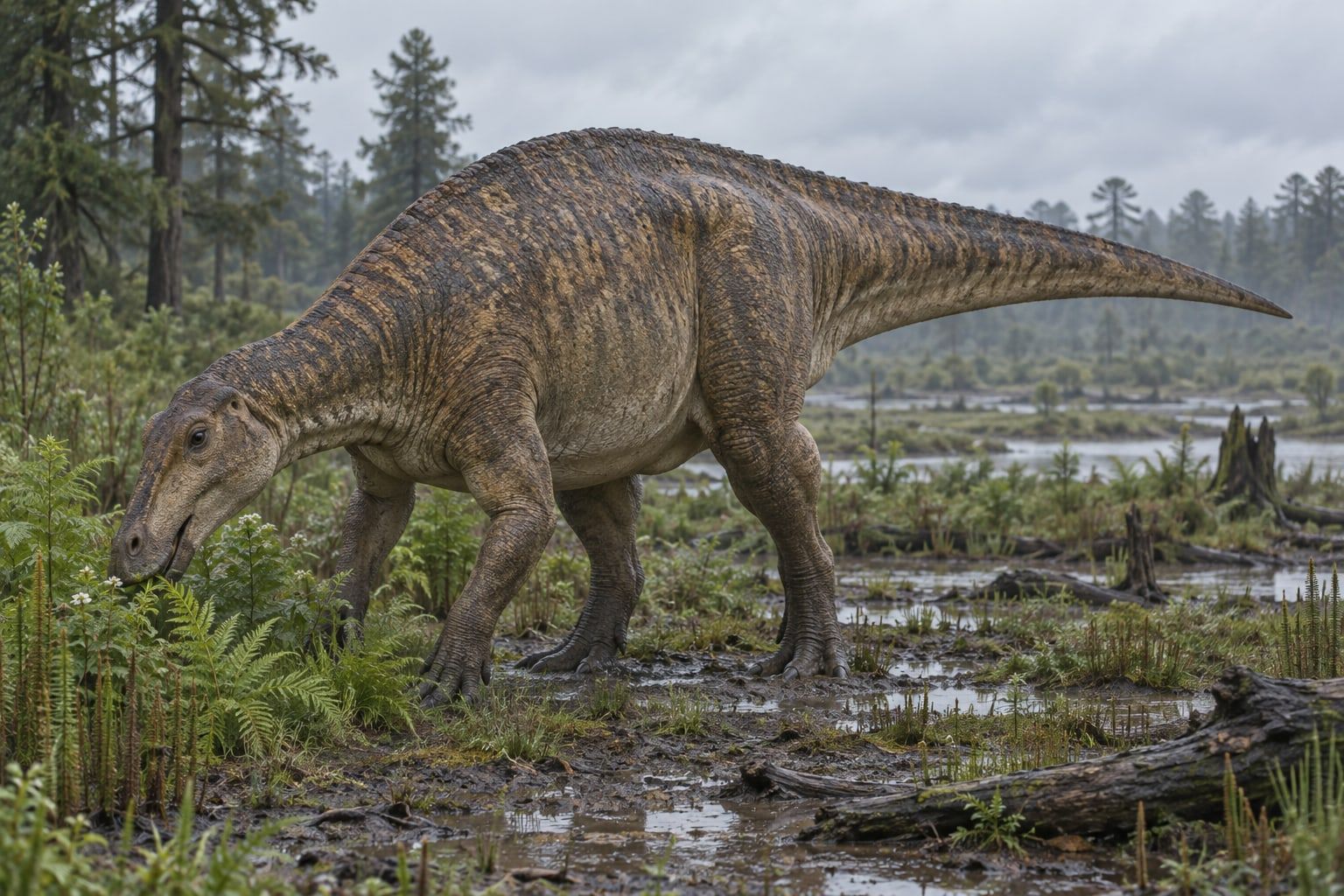
Hadrosaurus
HAD-ro-SORE-us
"bulky lizard"
DV-0017
- Lived
- 84 to 66 million years ago, Late Cretaceous
- Diet
- Herbivore
- Length
- about 9 m (30 ft)
- Group
- Ornithopods, Hadrosauridae
- Found in
- United States, Canada and Kazakhstan
- Named by
- Leidy 1858
Field notes
About Hadrosaurus
What it was like
Hadrosaurus was a large plant eater with a long, horse-like snout and rows of tightly packed cheek teeth suited for grinding tough plants. It grew to about 9 meters (30 feet) long, with front legs shorter than its back legs, so it probably walked on two legs while foraging and could drop to four when moving slowly.
Its beak-tipped jaws cropped leaves and twigs, and the many rows of teeth behind the beak formed a self-sharpening grinding surface known as a dental battery, a feature typical of its family.
Its world
Hadrosaurus lived from about 84 to 66 million years ago, in the Late Cretaceous, with its best-known fossils coming from New Jersey, in the United States. Fossils assigned to the genus have also been reported from Alberta, in Canada, and as far away as Kazakhstan.
It shared its world with predators such as Troodon, Albertosaurus, Gorgosaurus, and Daspletosaurus, and with other plant eaters, including Saurolophus and the crested Corythosaurus.
How it was found
Leidy named Hadrosaurus in 1858, based on bones found in New Jersey. It was one of the first dinosaur skeletons found in North America complete enough to show what the animal looked like, and it helped show that some dinosaurs walked upright on two legs. Around six fossil finds of Hadrosaurus are known today, and its closest relatives, all members of the duck-billed hadrosaur family, include Edmontosaurus, Parasaurolophus, and the crested Lambeosaurus.
The evidence
Where its fossils were found
Today
75 million years ago
To scale
How big was Hadrosaurus?
Lived alongside
Found in the same rock formations.
Close relatives
Other members of Hadrosauridae.
Sources: Paleobiology Database, WikidataNamed in: J. Leidy. 1858. [On the bones of a huge herbivorous saurian near Haddonfield]. Proceedings of the Academy of Natural Sciences of Philadelphia 10:215-218