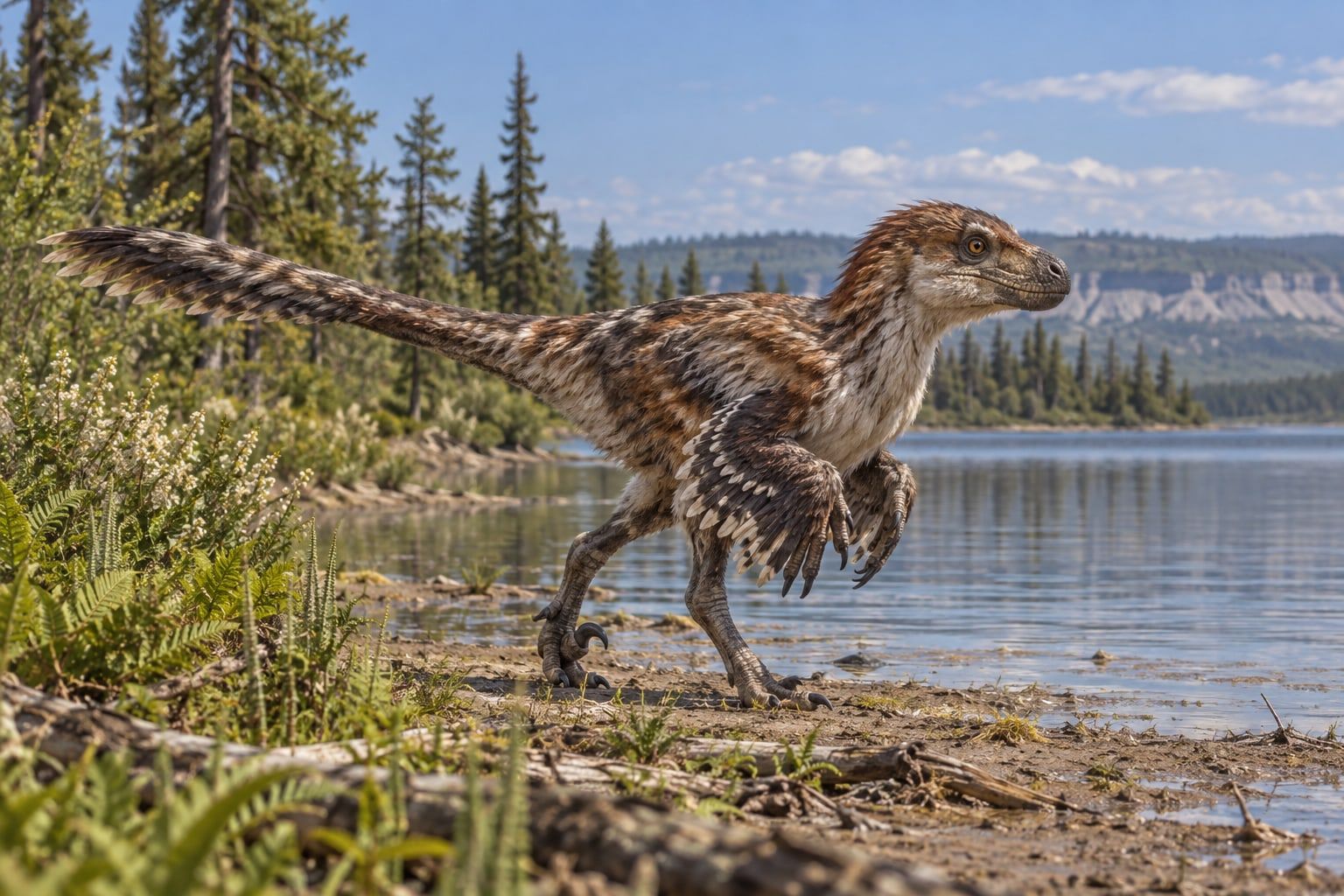
Atrociraptor
uh-TROSS-ih-RAP-tor
"savage robber"
DV-0533
- Lived
- 84 to 66 million years ago, Late Cretaceous
- Diet
- Carnivore
- Group
- Theropods, Dromaeosauridae
- Found in
- Canada
- Named by
- Currie and Varricchio 2004
Field notes
About Atrociraptor
What it was like
Atrociraptor was a small, sharp-toothed dromaeosaurid, much smaller than large relatives such as Utahraptor. Its skull was noticeably deep for its size, and its teeth curved backward more strongly than in most of its relatives, hinting at a bite suited to bigger prey than its size alone would suggest. Like other dromaeosaurids, it likely carried a large, curved claw on each second toe and was covered in feathers.
Its world
Atrociraptor lived in what is now Alberta, Canada, during the Late Cretaceous, between about 84 and 66 million years ago. Its remains, five finds in total, come from the Horseshoe Canyon Formation.
It shared this world with large plant eaters such as Edmontosaurus and Pachyrhinosaurus, the tyrannosaur Albertosaurus, and other small predators including Troodon and Ornithomimus.
How it was found
Currie and Varricchio named Atrociraptor in 2004. It belongs to Dromaeosauridae, the family of sickle-clawed predators that also includes Velociraptor, Deinonychus, and Utahraptor. With five known finds, it is a modestly documented member of the group, and its exact relationships within Dromaeosauridae are still being worked out.
The evidence
Where its fossils were found
Today
75 million years ago
Lived alongside
Found in the same rock formations.
Close relatives
Other members of Dromaeosauridae.
Sources: Paleobiology Database, WikidataNamed in: P. J. Currie and D. J. Varricchio. 2004. A new dromaeosaurid from the Horseshoe Canyon Formation (Upper Cretaceous) of Alberta, Canada. Feathered Dragons. Indiana University Press, Bloomington